Invoke flake8 in Python Project

I am a Software Engineer. I have worked with different languages like NodeJS and Python. I have keen interest in Backend Engineering, Cloud Native Technologies and System Architecture.
Flake8 is a popular lint wrapper for python. In this article, we will understand the uses of flake8 against our python projects.
What is flake8?
Install flake8 in your project
Run flake8 against your project
Configure flake8 in config.cfg
What is flake8?
Flake8 is a wrapper around these tools:
PyFlakes
pycodestyle
Ned Batchelder’s McCabe script
Flake8 runs all the tools by launching the single flake8 command. It displays the warnings in a per-file, merged output.
Install flake8
First, we need to create a project.
mkdir simple_calculator
Let's create a virtual environment inside the project and activate the virtual-env.
cd simple_calculator
python3 -m venv venv
source venv/bin/activatte
Now let's install flake8 in your project
pip install flake8
Let's add a file called calculator.py in your project and add the following content to it.
class calculator(object):
    def __init__(self, *args):
        super(calculator, self).__init__(*args)

    def addition(self, a, b):

        return a + b

    def Substraction(self, a, b ):
        return a - b

    def multiplication(self, a, b):
        return a * b


    def Division(self,a, b):
        return a / b
Run flake8 against your project
Now let's run flake8 against your project
flake8 --exclude=venv --count
In the above command --exclude providing a comma-separated list of glob patterns to exclude from checks and --count printing the total number of errors.
You can see the following in your terminal.
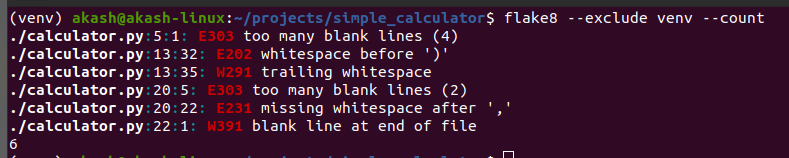
The error will come in this format by default - '%(path)s:%(row)d:%(col)d: %(code)s %(text)s' .
To know more about the options available with flake8, please visit the official documentation - https://flake8.pycqa.org/en/latest/user/options.html.
Configure flake8 in config.cfg
You can pass flake8's configuration parameters using a setup.cfg file. You can add the following configuration in your config.cfg file.
[flake8]
exclude =
    .git,
    __pycache__,
    venv
max-complexity = 10
count = True
Now you can just run flake8 in your terminal and able to see the same result.

You can resolve the errors in your code one by one. It's quite clear from the warning we're getting in flake8-generated logs. Then you should be able to get the count as 0.
We have reached the end of this short article. I hope you understand the purpose of flake8 in python and you'll be using flake8 in your next project.
Happy Learning!!


